Overview
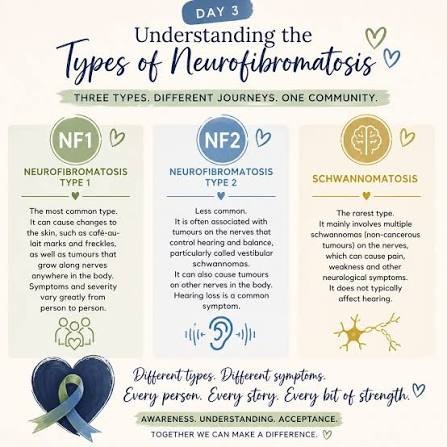
Neurofibromatosis (NF) is a group of autosomal dominant conditions that involve the development of tumors that affect the brain, spinal cord, and nerves. Most tumors are non cancerous but some may become cancerous. There are 4 main types: NF1, NF2, SMARCB1-related Schwannomatosis, and LZTR1-related Schwannomatosis. Each of these are distinct and carry different genetic mutations.
Neurofibromatosis Type 1
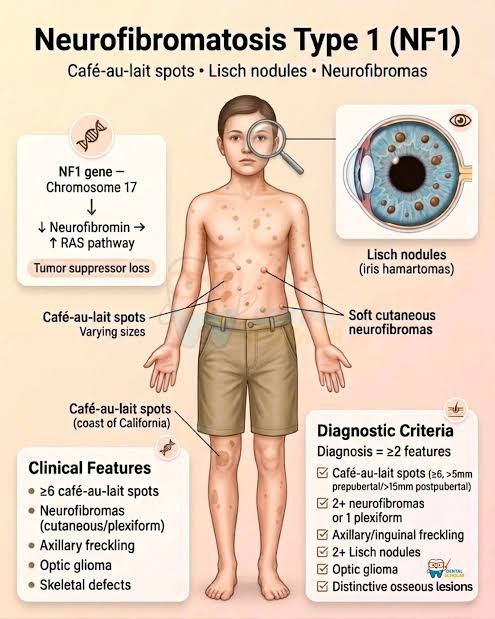
NF1 is a genetic condition that changes normal skin pigment and causes tumors on nerve tissue. These tumors grow throughout the nervous system. About 1 in 2500 children are born with this condition. This condition is usually seen at birth and almost always by age 10. NF1 is caused by an altered gene that is passed down by a parent or occurs at conception. This gene is located on chromosome 17 and it produces a protein called neurofibromin that helps regulate cell growth. When this gene is altered it can’t produce neurofibromin which leads to the rapid growth of cells. NF1 has an autosomal dominant inheritance pattern meaning there’s a 50% chance at a parent passing down this disease.
Symptoms
Symptoms usually tend to be mild to moderate and show up by age 10. They include:
- Light brown spots on the skin known as cafe au lait spots. These spots are common in healthy people but having more than 6 points to NF1
- Freckling in the armpits or groin area
- Tiny bumps on the iris of the eye, known as Lisch nodules
- Soft, pea-sized bumps on or under the skin called neurofibromas
- Bone changes
- Tumor on the nerve that connects the eye to the brain, called an optic pathway glioma
- Learning disabilities
Neurofibromatosis Type 2
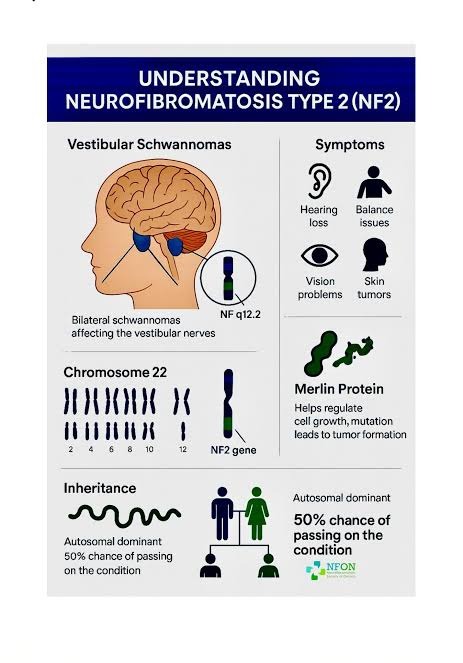
NF2 is a genetic condition that again causes the growth of tumors. Tumors include: vestibular schwannomas Meningiomas and ependymomas, which can affect the brain and spinal cord, and schwannomas, which can affect peripheral nerves. The changes in the gene can be present since birth but symptoms usually arise during teen years or early twenties. Symptoms for NF2 vary but vestibular schwannomas in both ears is extremely common which can cause
- Dizziness
- Hearing loss
- Tinnitus
- Issues with balance
- Trouble walking
Eyes are also affected with juvenile cataracts being the first symptom of NF2 in earlier years. Skin symptoms however, are far less common in NF2 than NF1. Neurofibromatosis type 2 is caused by a change in the NF2 gene found on chromosome 22. This gene makes merlin protein that regulates cell growth. When it’s altered it can’t make Merlin and cells begin to multiply rapidly.
SMARCB1-related Schwannomatosis and LZTR1-related Schwannomatosis
These two types of schwannomatosis typically affect people after age 20 with symptoms appearing between ages 25 and 30. They cause slow-growing nerve sheath tumors that can develop on nerves in the brain, spine and peripheral nerves throughout the body. These types of schwannomatosis are caused by changes to the SMARCB1 or LZTR1 genes. Both of these genes are tumor suppression genes and when they become altered it causes cells to divide rapidly and uncontrollably. While these changes can be inherited by a parent, most cases are spontaneous meaning they happen randomly and for the first time in a family. Symptoms of these 2 types of Schwannomatosis include:
- Long lasting pain anywhere in the body
- Numbness or weakness in parts of the body
- Muscle loss in areas where nerves are affected
- Balance problems or hearing changes depending on tumor location
Treatment
Currently there is no cure for any of the 4 types of Neurofibromatosis. Instead treatment focuses on regular monitoring, managing symptoms, and surgeries to remove problematic tumors. Some medications can help shrink tumors while some medicines can help to manage chronic pain.
Sources
- Neurofibromatosis | National Institute of Neurological Disorders and Stroke. (n.d.-h). https://www.ninds.nih.gov/health-information/disorders/neurofibromatosis
- Mayo Foundation for Medical Education and Research. (2026, July 14). Neurofibromatosis type 1. Mayo Clinic. https://www.mayoclinic.org/diseases-conditions/neurofibromatosis-type-1/symptoms-causes/syc-20350490
- Neurofibromatosis type 2 (NF2) | Johns Hopkins Medicine. (n.d.). https://www.hopkinsmedicine.org/health/conditions-and-diseases/neurofibromatosis/neurofibromatosis-type-2
- Mayo Foundation for Medical Education and Research. (2026, February 6). Schwannomatosis. Mayo Clinic. https://www.mayoclinic.org/diseases-conditions/schwannomatosis/symptoms-causes/syc-20567542
- Le, C. (2025, May 4). Neurofibromatosis. StatPearls [Internet]. https://www.ncbi.nlm.nih.gov/books/NBK459329/