Overview
Kuru is a rare type of prion disease that originated in Papua New Guinea and spreads through cannibalism. It likely began when someone with a sporadic prion disease (likely CJD- common, can happen randomly) was eaten. The cause of prion diseases is a misfolded form of a host encoded protein called prion (PrP) the normal form is PrPc and the misfolded one is PrPsc. The misfolded protein causes normal proteins to become misfolded and they accumulate in the brain, forming clumps that cause brain damage, sponge like holes in brain tissue and nerve cell death.
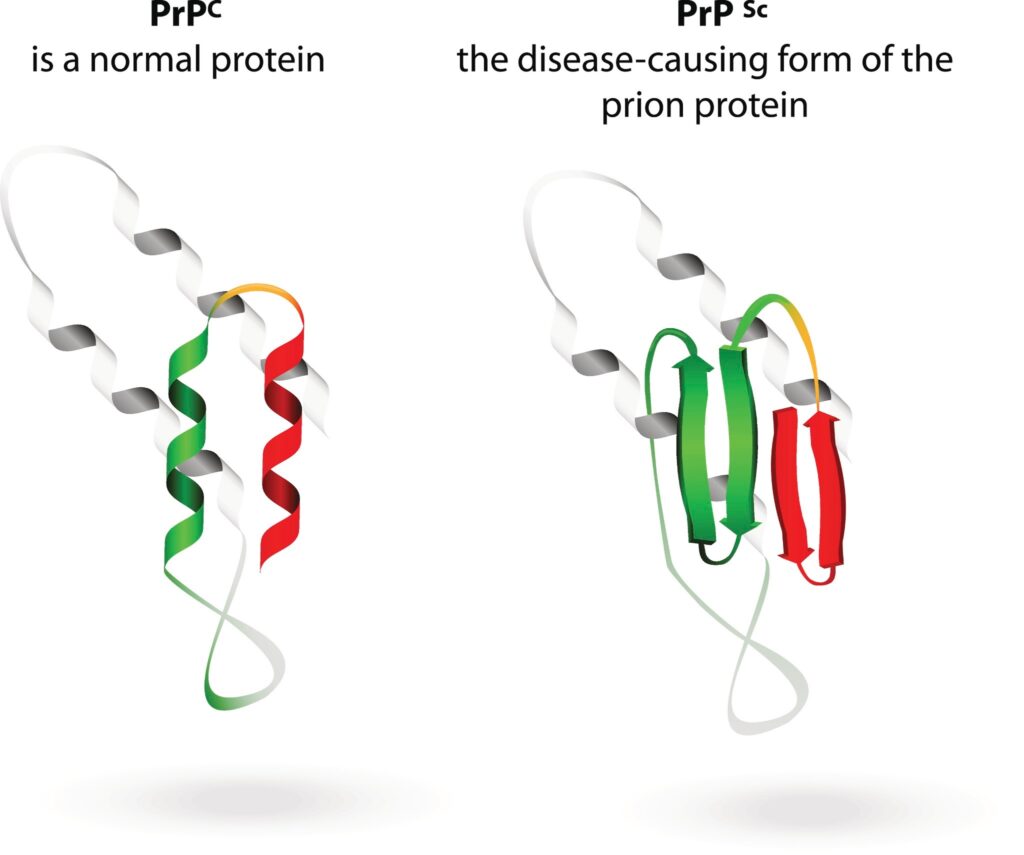
PrPsc goes around bumping into normal proteins and turning them into the misfolded version. Only 1 misfolded prion protein is needed to lead to an exponential increase in the amount of PrPsc in your body.
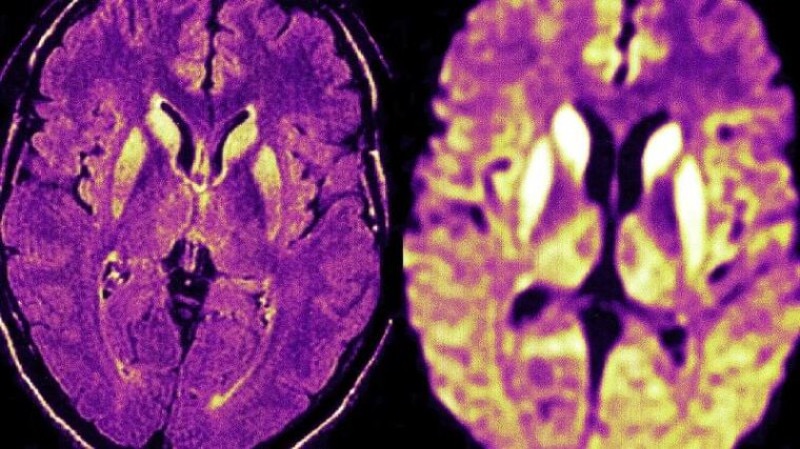
The normal brain is to the left. The infected brain is to the right. Your immune system can’t do anything against a prion disease since these proteins belong to you, they are not foreign and they aren’t viruses or bacteria that the immune system would pick up on or attack.
Symptoms
- Body tremors
- Random bursts of laughter
- Loss of coordination and control over muscle movements
- Dementia
- Comas
- Death
Symptoms can take years to appear and the asymptomatic phase averages 10-13 years. Once symptoms start life expectancy is typically 12 months. In the beginning, the main symptoms of kuru are usually tremors and ataxia. As the disease progresses the frequency and intensity increases and people may develop muscle jerks. Kuru causes extreme emotional instability that usually results in loud uncontrollable bursts of laughter or tears which is why it was also known as the “laughing sickness”.
How It Works
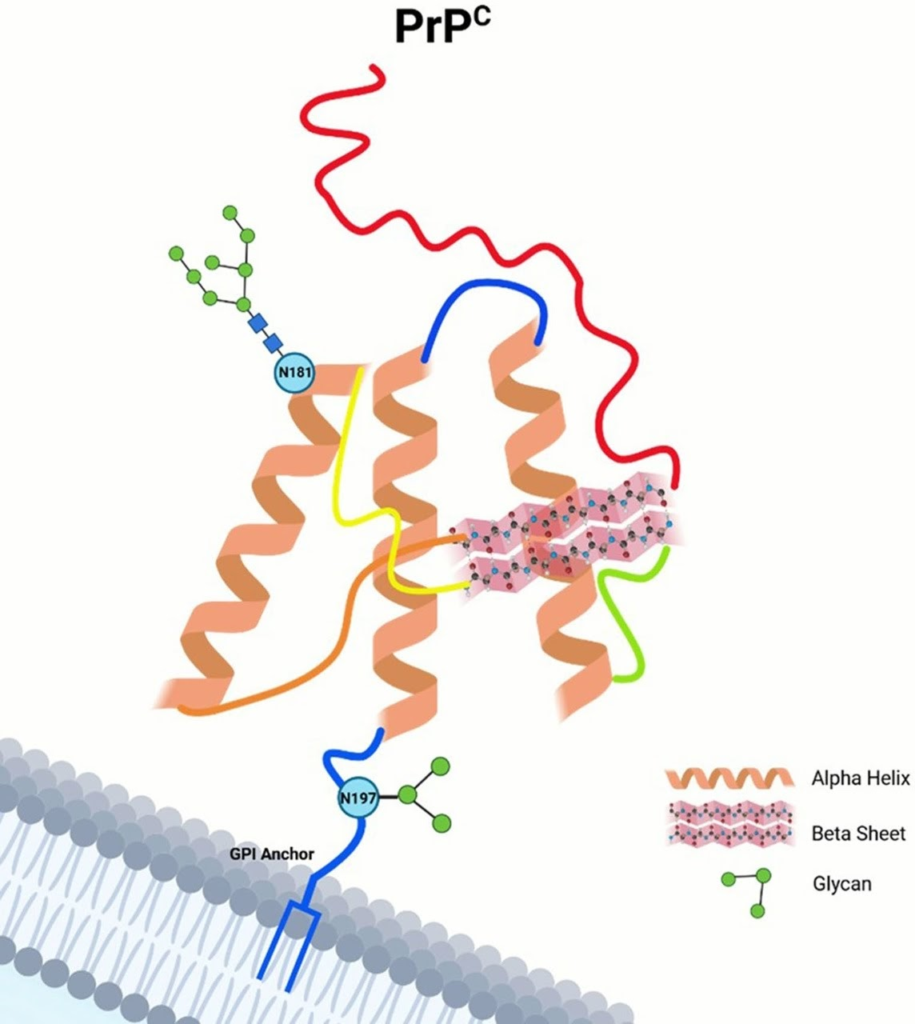
Normally, the prion protein (PrPc) attaches to the outer surface of the neurons by a GPI-anchor and participates in cell signaling within a human’s brain and nervous system without entering the cell. When PrPc interacts with other partners such as NCAM it results in the transduction of Fyn Kinase and activates it, which triggers ERK (Extracellular-signal regulated- Kinase), which regulates gene expression regarding neuronal growth and differentiation or PI3K, which promotes cell survival and resistance to apoptosis. This in return promotes neuron survival, synaptic plasticity and neuroprotection.
However, as people consume brain tissue that contains PrPsc, it enters the nervous system and interacts with the current PrPc protein. This causes folding, as PrPc alpha helices become to beta sheets, affecting the secondary and tertiary structure of the protein. This doesn’t allow the protein to bind normally and prevents transduction to activate Fyn Kinase. Without the activation of Fyn Kinase, pathways such as ERK or PI3K never get activated, leading to synaptic failure, neuron death and brain tissue degeneration.
Treatment
There is no cure for kuru. However, Kuru began through a cannibalistic tradition of the people of Papua New Guinea. After the outbreak of Kuru the people discontinued the practice and Kuru is now essentially extinct. While you can’t treat Kuru, there are medications people can take to manage symptoms like analgesics that don’t cause the loss of consciousness. Physical therapy can also be a helpful tool as motor functions and coordination decline.
Sources
- Kuru disease (anthropology) | anthroholic. (n.d.-c). https://anthroholic.com/kuru-disease
- Kuru: What is it, causes, signs and symptoms, and more | osmosis. (2025, October 17). https://www.osmosis.org/answers/kuru
- Kuru: Causes, symptoms and diagnosis. (n.d.-c). https://www.healthline.com/health/kuru
- The cellular prion protein (prpc): Its physiological function … (n.d.-f). https://pmc.ncbi.nlm.nih.gov/articles/PMC1986710/
- Cellular prion protein (prpc): Putative interacting partners and … (n.d.-c). https://pmc.ncbi.nlm.nih.gov/articles/PMC7583789/
- Kuru – StatPearls – NCBI Bookshelf. (n.d.-d). https://www.ncbi.nlm.nih.gov/books/NBK559103/
- Kuru: The neurodegenerative disorder; roles of PRPC and prpsc in infection, effects in blocking neural synapses and its comprehensive observation | iris publishers. (n.d.-g). https://irispublishers.com/ann/fulltext/kuru-the-neurodegenerative-disorder-roles-of-prpc-and-prpsc-in-infection.ID.000717.php