Overview
Parkinson’s disease (PD) s a progressive neurological disorder that causes the death of neurons that produce dopamine in a part of the brain called substantia nigra (SN) leading to a shortage of dopamine.
It mainly affects movement and worsens over time. As symptoms progress, people with PD have difficulty walking, talking, and completing day to day tasks. In the late stages of the disease people may become bedridden or wheel chair bound.
Symptoms
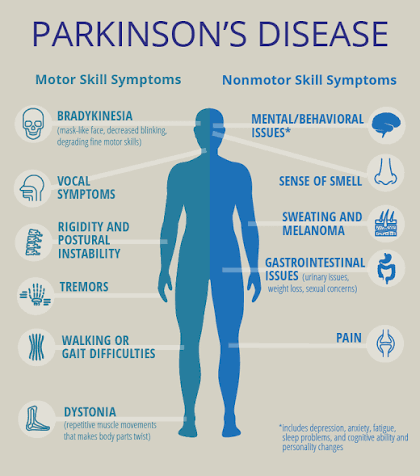
Symptoms usually develop and progress slowly over years and progression usually varies from one person to another. They are 2 types of symptoms that arise with Parkinson’s: motor symptoms and non-motor symptoms. Motor symptoms are related to movement and non-motor are the symptoms that don’t affect your movement. Some symptoms include
- Tremors:
- Slowed movement
- Limb stiffness
- Gait and valence problems
- Depression
- Anxiety
- Sleep disorders
- Cognitive disorders
Non-motor symptoms often come before motor symptoms, sometimes years or even decades in advance. There are certain symptoms that are extremely likely to come early and they include:
- Depression
- Constipation
- Loss of smell
- Sleep disorders
- Fatigue
Physiology
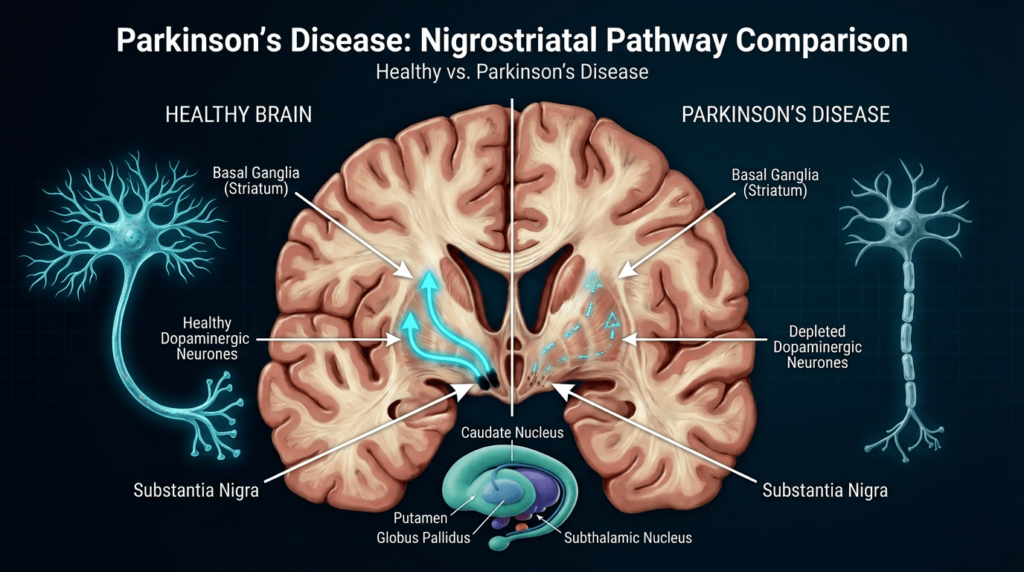
PD primarily affects the substantia nigra. The SN is a part of your brain responsible for controlling movement. It’s part of the basal ganglia (a group of structures that form connections throughout your brain). The main role of the SN is to produce dopamine to regulate reward and motivation and control movement.
The substantia nigra has 2 different sections each with different roles. The first section is the SN pars reticulata and it has connections that deal with the movement of your eyes as well as your ability to learn and think. Cells in this area have a chemical called GABA (gamma-aminobutyric acid). This chemical is used by the brain to stop signals that it decides should not go to your muscles. The second part is called the SN pars compacta. Neurons in this part hold dopamine and have connections related to emotions, motivation, and risk vs reward.
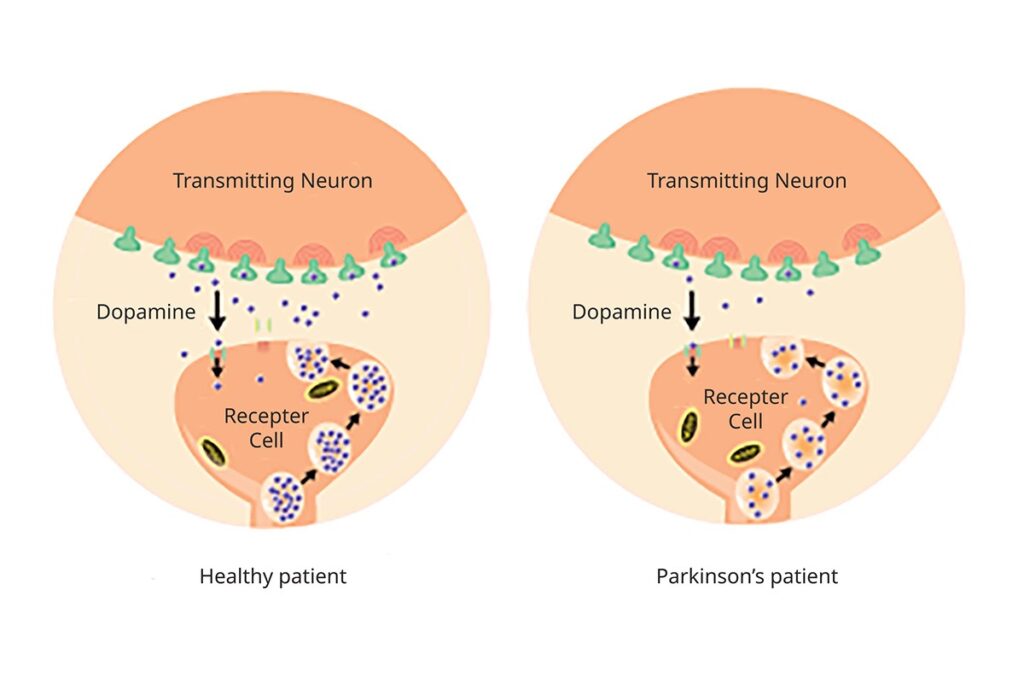
In Parkinson’s disease neurons that produce dopamine become damaged and die. Dopamine is a neurotransmitter (chemical messenger) that helps the brain send signals for smooth intentional movements, regulate automatic movements like blinking, and influences mood, motivation, and reward pathways. By the time symptoms appear most people with PD have lost around 60-80% of dopamine producing cells in the substantia nigra.
PD also causes damage to cells that make norepinephrine. Norepinephrine is the main chemical messenger that is involved in things the body does automatically like keeping blood pressure steady and the heart beating. This decrease in norepinephrine caused by PD is thought to explain some of the non motor symptoms like fatigue or blood pressure changes.
Anatomy of Substantia Nigra
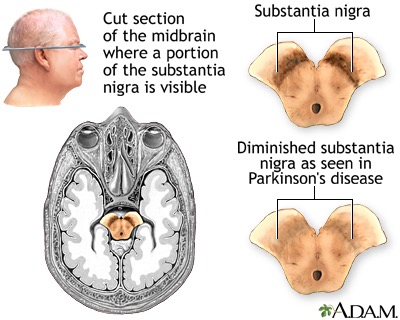
The SN is in your midbrain towards the center. It’s right above your brain stem. Your body actually has 2 substantia nigra structures on either side of your midbrain. Both these have the SN pars reticulata and SN pars compacta. While most of your brain is a lighter shade of pinkish gray the SN is darker because the brain here contains melanin. It’s very small with 25 of those structures being able to fit inside a golf ball. It’s made up of primarily neurons and glial cells (support cells for neurons/nervous system).
Causes
The cause of PD is unknown, but certain factors do play a role. For example, genes may influence whether or not someone gets PD. Certain genetic changes are linked to PD and people with family members that have PD have a higher risk of getting it themselves. Another factor is environmental conditions. Exposure to toxins or other factors could increase the risk of PD. The major risk factors for PD are the following;
- Age- The risk for PD increases with age usually starting after 50. It’s possible to occur during a younger age but is rare.
- Genetics- Certain genetic changes or having family with PD
- Sex- Males are more likely to get PD
- Toxins- Harmful chemicals or pesticides may increase risk
Treatment
There is no cure for PD but there are medications that can improve symptoms.
3 main types of medications are
- Medicines that increase brain dopamine levels. Levadopa is a commonly used medication that turns into dopamine after entering the brain.
- Medications that affect the levels of other brain chemicals to ease tremors.
- Medications that treat the non motor symptoms such as antidepressants for depression.
Sources
- What is parkinson’s? Parkinson’s Foundation. (n.d.). https://www.parkinson.org/understanding-parkinsons/what-is-parkinsons
- Rebecca Gilbert, M. (2026, July 6). What are the first symptoms of parkinson’s disease? American Parkinson Disease Association. https://www.apdaparkinson.org/article/first-symptoms-of-parkinsons/
- Mayo Foundation for Medical Education and Research. (2024, September 27). Parkinson’s disease. Mayo Clinic. https://www.mayoclinic.org/diseases-conditions/parkinsons-disease/symptoms-causes/syc-20376055
- Parkinson’s Disease | National Institute of Neurological Disorders and Stroke. (n.d.-h). https://www.ninds.nih.gov/health-information/disorders/parkinsons-disease
- professional, C. C. medical. (2025, December 22). Substantia nigra (SN): What it is, Function & Anatomy. Cleveland Clinic. https://my.clevelandclinic.org/health/body/23010-substantia-nigra-sn